Problem
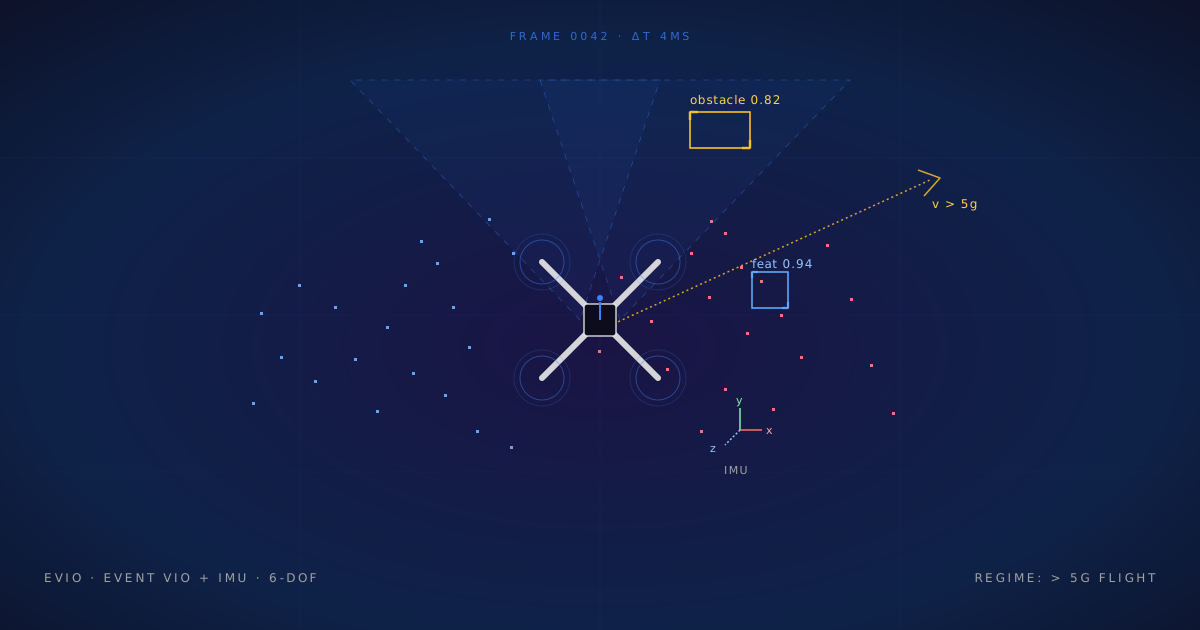
Conventional frame-based cameras suffer motion blur at high angular and linear velocity, causing standard visual-inertial odometry (VIO) to diverge during aggressive quadrotor maneuvers exceeding 5g acceleration.
Built
A PyTorch fusion architecture combining neuromorphic event-camera streams (asynchronous per-pixel brightness changes, microsecond resolution) with IMU data for continuous 6-DOF pose estimation — event-stream tensor representations, a recurrent temporal-fusion network trained on high-speed flight datasets with motion-capture ground truth, optimized for onboard ROS-integrated inference.
Why hard
Event cameras eliminate motion blur but require fundamentally different processing than standard frame-based VIO pipelines.
What happened
The system maintained accurate pose tracking through maneuvers exceeding 5g acceleration — the regime where conventional frame cameras and standard VIO diverge.