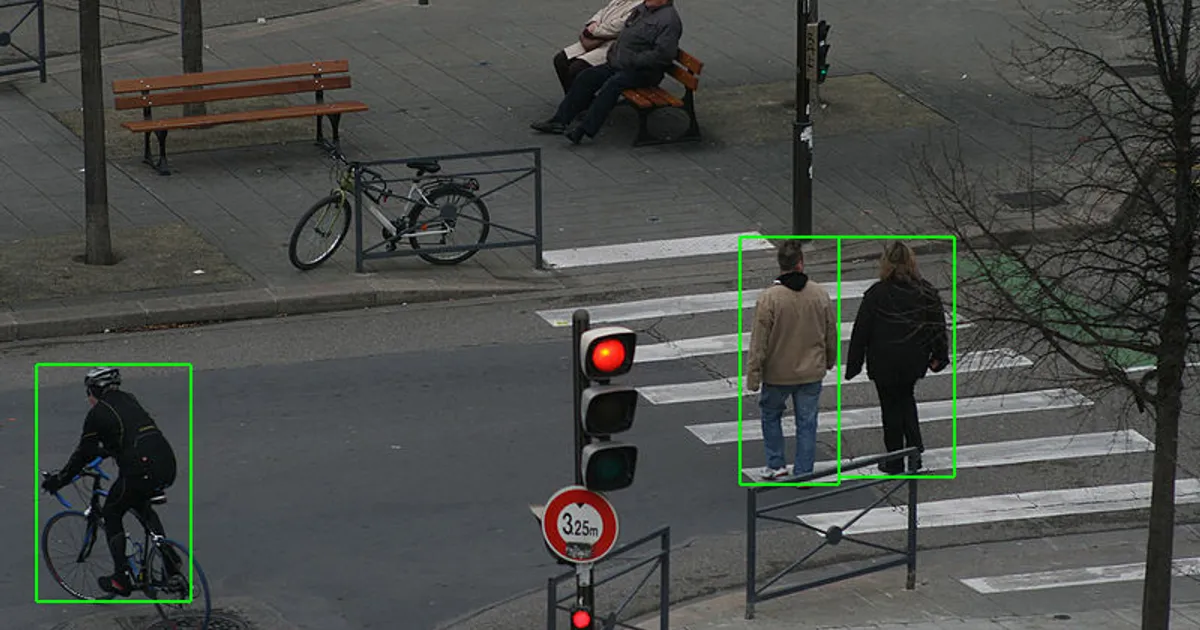
Overview
Across 2022–2023 I shipped four versions of “detection + tracking + ReID” — single-person tracking on a Loomo robot, multi-person pose tracking, a ReID demo on Colab, and the perception module of a full ROS autonomy stack. Each solved a real problem in its context. None of them shared an interface; all four ran on dependency stacks that aged out.
perception-pipeline is the consolidated re-do against the 2026 stack: modern YOLO (v8/v11), ByteTrack / BoT-SORT / OC-SORT, OSNet-class ReID, MMPose-compatible 2D and 3D pose, with TensorRT export targets for edge deployment on Jetson-class hardware.
What v0.1 ships (June 2026)
A runnable detector + tracker loop with the architecture the rest of the roadmap will plug into.
- Narrow interfaces —
DetectorandTrackerabstract base classes; every primitive lives behind one. Swap modules without touching the rest. - YOLO detection —
ultralyticswrapper, any checkpoint (yolov8nby default). - ByteTrack association — via the
supervisionpackage; persistent track IDs across frames. - CLI demo —
perception-demo --input video.mp4 --output annotated.mp4. Latency summary printed on exit (per-module mean / p95, effective FPS). - Type contracts —
Detections,Tracks,FrameResultcarry per-module latencies so the runtime can budget downstream stages. - MIT-licensed, pip-installable —
pip install -e .and you’re running.
Design principles
- Modules over monoliths. Every primitive (detector, tracker, ReID, pose) is a stand-alone class behind a narrow interface; the pipeline is a composition.
- One config file per scenario. No hand-edited launch scripts. YAML in, pipeline out. (Config-loading lands in v0.2.)
- Latency-budget-aware. Every module reports measured latency; the runtime can downgrade or skip modules to hit a target frame budget.
- Platform-agnostic core, platform-specific shims. ROS / standalone / SDK adapters live at the edge.
Roadmap
- ✅ v0.1 — Detection + tracking baseline (YOLO + ByteTrack), CLI demo, latency reporting. Shipped June 2026.
- v0.2 — ReID hook (OSNet baseline), multi-person tracking, YAML pipeline config
- v0.3 — 2D pose estimation (MMPose-compatible)
- v0.4 — 3D pose lifting + temporal smoothing
- v0.5 — Edge deployment (TensorRT export, Jetson Orin baseline, FP16 + INT8)
- v0.6 (stretch) — VLM-conditioned tracking (“track the person in the red jacket”)
Ancestors
The historical record — these still run on their original dependency stacks:
- Perception-Pipeline (2022) — single-person detection + tracking, method comparison
- ReID (2022) — YOLO + ReID demo notebook · repo under maintenance
- PostureTrack (2023) — modular pose tracking, single + multi-person · repo under maintenance
- ROS_Autonomous_Driving perception module (2023) — same primitives wrapped in ROS for the Loomo robot
Why open
Public, MIT-licensed, modular — designed to be useful to whoever picks it up and an honest demonstration of how I think about real-time vision systems.