Method public: github.com/thrmnn/ros2-localization-triage
Problem
A robot misbehaves at a customer site and someone has to comb the bag files and logs to find out why.
Built
Four independent fault detectors for ROS 2/ROS 1 localization pipelines — sensor dropout, transform jumps, covariance spikes, pose divergence — tested against 108 minutes of real recordings from five robot platforms (Cartographer backpack rigs, a Tiago, a MiR100 AGV, a PR2, a handheld 3D rig), all public third-party benchmark data, not a live customer fleet. Every graded figure recomputes from a committed artifact with one script, check_numbers.py; the cross-platform flag rates recompute from the flag count and duration stated in their own row, bag linked. Clone the repo and run it.
Why hard
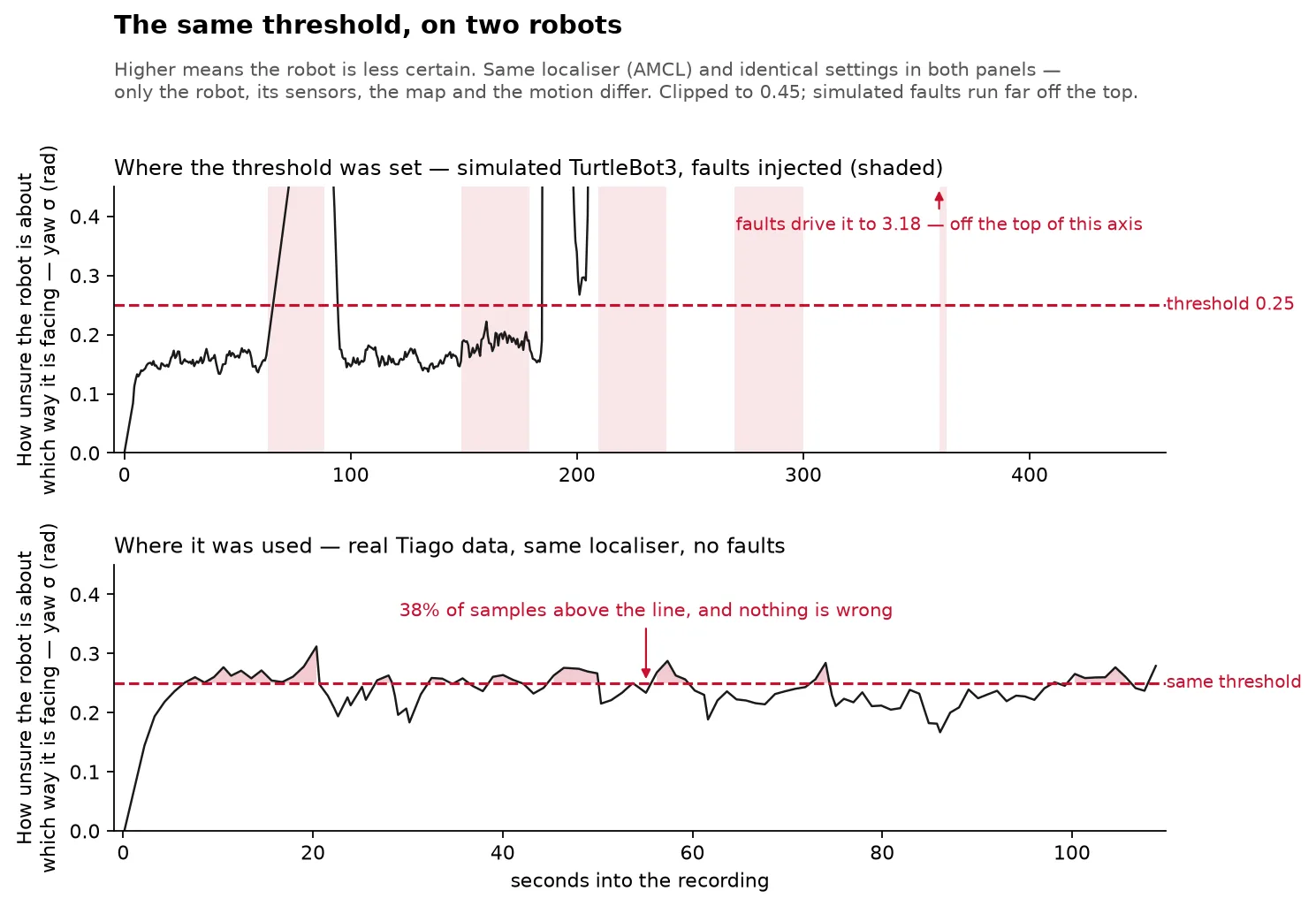
The same frozen thresholds did not transfer. The covariance threshold, set on a simulated TurtleBot3, sits inside a real Tiago’s healthy yaw noise and fired five times on a recording with nothing wrong, graded wrong in the case log. A threshold is a property of the machine it was measured on, not of the failure. That is cross-platform transfer, not fleet calibration; calibrating to a live fleet’s own robots is what an engagement builds.
What happened
- 16 of 16 labelled laser gaps found, against labels the tool’s author never wrote (the Cartographer dataset’s own decade-old ground truth).
- Three predictions were committed before the ERL benchmark run. Two held, including that the laser-gap detector would show no elevation on the engineered failure runs: it fired zero times over 1,013 seconds. The prediction that the transform detector would not rise did not hold.
- Two case-log rows are graded “wrong” and published as such.
- One candidate dataset was rejected over its licence, not for a technical reason.